
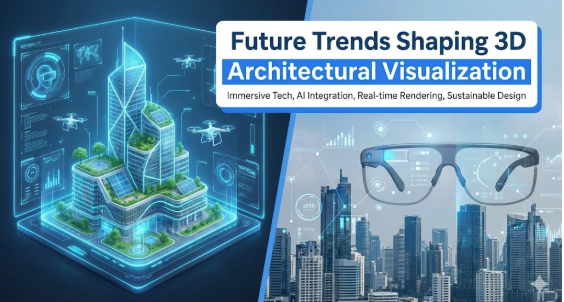
Architectural visualization tools progress at an accelerated pace because architectural design processes progress faster than ever before.
People now experience future building designs through interactive virtual environments, which replace traditional static building rendering methods.
3D architectural visualization has evolved into a field that enables people to experience a virtual space instead of its original purpose of displaying building designs.
Technological progress introduces fundamental changes that drive industry transformation through three main trends.
The new technologies that 3D visualization companies must adopt enable them to meet contemporary architect and developer needs.
The Rise of Real-Time Rendering
Rendering a high-quality 3D image required hours or days under previous methods, which produced 3D images of superior quality.
The architectural visualization industry has experienced its most important transformation through the introduction of real-time rendering technology.
Designers can view their design modifications immediately after making changes because advanced gaming engines power this technology.
The system now allows users to change materials and lighting while moving walls without having to wait for the “bake” process to complete.
The design process helps from quick work performance, while designers can use interactive sessions to relate with clients via their collective structure work.
Immersive Virtual and Augmented Reality
Virtual Reality (VR) and Augmented Reality (AR) have achieved the status of paramount experienced tools after starting as unknown technologies.
The experienced 3D visualization company delivers clients with a virtual reality experience, which encourages them to examine their prospective home or office facility through a headset.
AR equips extra functionality that stimulates users to see virtual architectural models placed on real building sites where construction will occur.
The project reaches emotional influence through its immersive experience, which allows stakeholders to perceive spatial dimensions through their physical presence in the space.
AI-Driven Design and Automation
AI technology allows 3D architectural visualization through its capability to automate repetitive tasks, which permits workers to concentrate on their important job commitments.
AI systems now help users design realistic textures while they create furniture arrangements and improve lighting systems through actual environmental effects.
The technology enables 3D visualization companies to create better artistic work through its automatic production process.
AI provides architects with sunlight analysis throughout the year, which enables them to design sustainable and comfortable spaces through data-driven architectural analysis.
Digital Twins and the Integration of BIM
The “Digital Twin” concept has gained importance for companies that operate large commercial and urban development projects.
A digital twin exists as a complete 3D model that exists in real-time connection with its physical twin.
3D architectural visualization integrated with Building Information Modeling (BIM) enables companies to create digital models that achieve complete architectural realism through material data, building structural information, and energy consumption data.
The trend transforms building visualization into a permanent management solution that architects use throughout every stage of building operation.
Hyper-Realism and Digital Storytelling
3D architectural visualization achieves its highest level of realism through advanced hardware, which enables visual content to closely match actual photography.
The digital storytelling trend shows how rendering artists now combine cinematic effects with visual elements such as lens flares, motion blur, and weather patterns, which resemble real weather conditions.
The project uses design elements that display architectural features together with design elements that create specific emotional experiences.
Hyper-realism creates experiences that developers use to market their spaces because people usually find space feelings more convincing than they find design elements.
Conclusion
The future development of 3D architectural visualization technology will proceed through three fundamental characteristics, which will create immersive experiences while intelligent processes deliver immediate outcomes.
The current technological landscape, which includes real-time rendering, virtual reality, artificial intelligence, and digital twins, leads to a single objective that aims for complete visual transparency.
The tools allow architects and developers to create precise data visualizations, which enable clear architectural understanding through their actual architectural designs.
The 3D visualization company helps industry professionals stay updated on current trends while they create more productive workplaces through modern technologies
